

The product development process: From Brief to Brand
A beauty product doesn’t move from idea to finished goods in one straight line. Understanding the development process — and how each decision affects the next — can help brands navigate it more effectively.
Once you've defined what you want to build, what happens next?
This is where product development begins moving from an idea on paper toward a finished product—and where the process can quickly become more complex than it initially appears.
A successful beauty product isn't simply the result of a great formula. Formula development, packaging, manufacturing, testing, cost, timing and commercialization are interconnected, and decisions made in one area can affect several others.
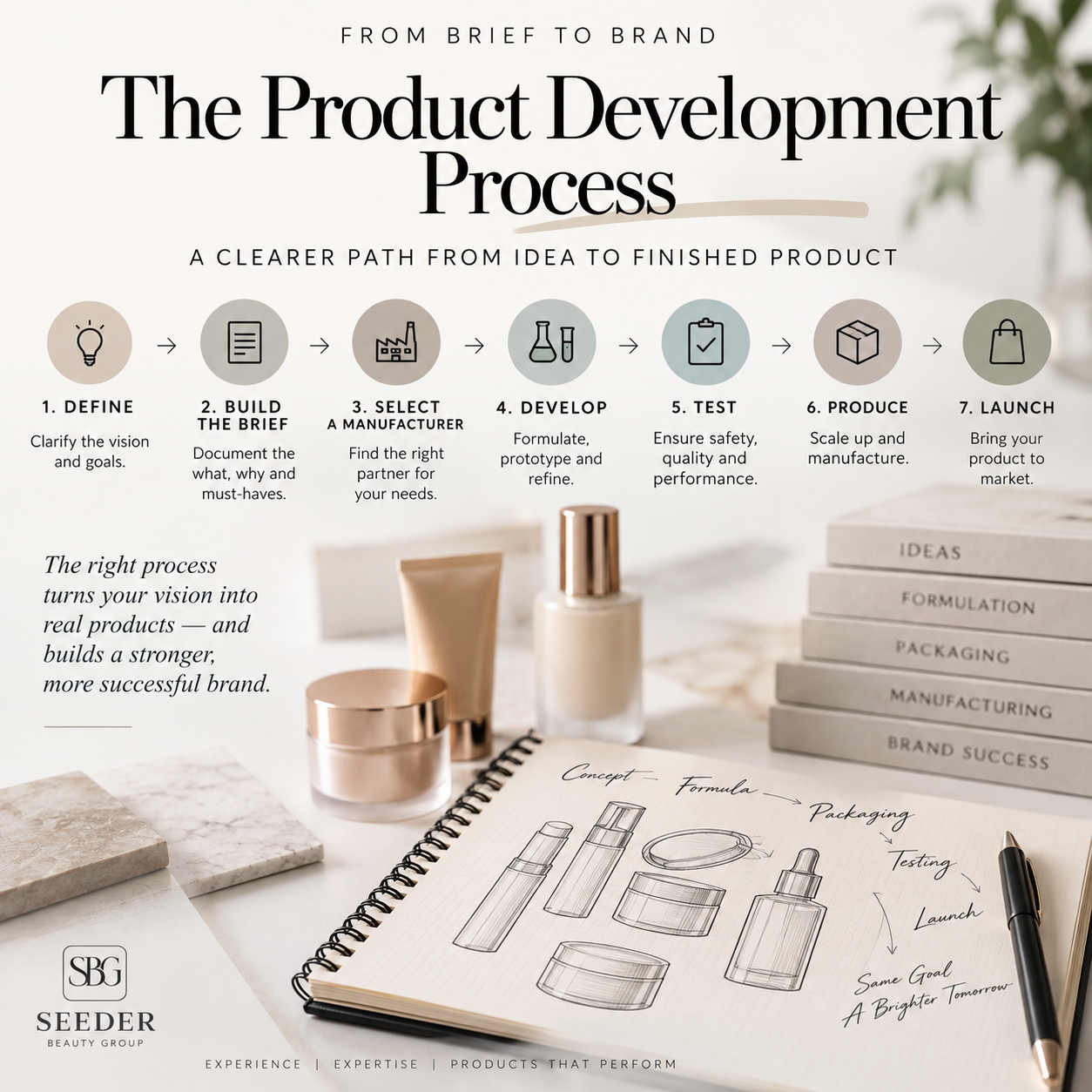
While every project is different, I generally think about the product development path in seven key stages.
1. DEFINE
Before development begins, get clear on what you're actually trying to create.
What is the product? Who is it for? What problem does it solve? What should the experience be? What makes it different? Where should it sit in the market?
This is also the time to begin thinking about target retail price, cost expectations, launch timing and projected quantities.
The clearer the vision is at the beginning, the easier it becomes to make informed decisions later.
2. BUILD THE BRIEF
The development brief translates the vision into something R&D and manufacturing partners can actually work toward.
It should communicate the product concept, target consumer, benchmarks, desired performance, sensory characteristics, non-negotiables, packaging direction, commercial targets and timing.
A good brief doesn't guarantee a perfect first submission.
It gives your development partners the clearest possible starting point.
3. SELECT THE RIGHT MANUFACTURING PARTNER
Technical capability matters—but it's only part of the decision.
The right partner also needs to understand what you're trying to build and be able to support the requirements of the project.
That means evaluating capabilities, communication, development flexibility, MOQs, cost structure, testing support, packaging experience, production capacity, timelines and the manufacturer's ability to support the brand as the product moves toward commercialization.
4. DEVELOP
Now the concept begins becoming tangible.
Formula submissions are evaluated, feedback is communicated to R&D, benchmarks are revisited and the product is refined.
This process is rarely perfectly linear.
A change intended to improve one characteristic can affect another, which is why thoughtful evaluation and clear communication with R&D are so important throughout development.
5. TEST
Once you're getting closer to the intended product, testing becomes critical.
The specific testing plan depends on the product, formula, packaging, claims and regulatory requirements, but the objective is the same: ensuring the finished product is safe, stable, compatible and capable of performing as intended.
Testing should be considered as part of the development plan—not something discovered at the very end.
6. PRODUCE
An approved laboratory sample is not yet a finished product.
Development now has to translate successfully into scaled manufacturing.
Production quantities, components, specifications, quality standards, lead times, filling, assembly, inspections and logistics all need to come together.
This is where disciplined commercialization becomes especially important.
7. LAUNCH
Finished goods are ultimately the goal—but getting there successfully requires coordination long before production begins.
By the time product reaches this stage, the work completed throughout development should have created a clear path from the original vision to something that can actually be manufactured, delivered and sold.
Product development doesn't happen in isolation
Of course, building and launching a successful beauty brand involves much more than product development alone.
Brand development, marketing strategy, sales-channel development, retail strategy, forecasting, inventory planning and many other business decisions happen alongside—and often influence—the product development process.
My focus here is specifically on the product development and commercialization path.
And even within these seven stages, there can be dozens of decisions, checkpoints and pivots along the way.
The process is rarely perfectly linear. But having the right roadmap makes it much easier to navigate.