
A Great Manufacturing Partnership Goes Both Ways
Finding the right manufacturing partner matters. But even the best R&D team needs clear direction. Strong product development happens when the brand and manufacturer understand the goal, communicate clearly and work collaboratively toward the same outcome.
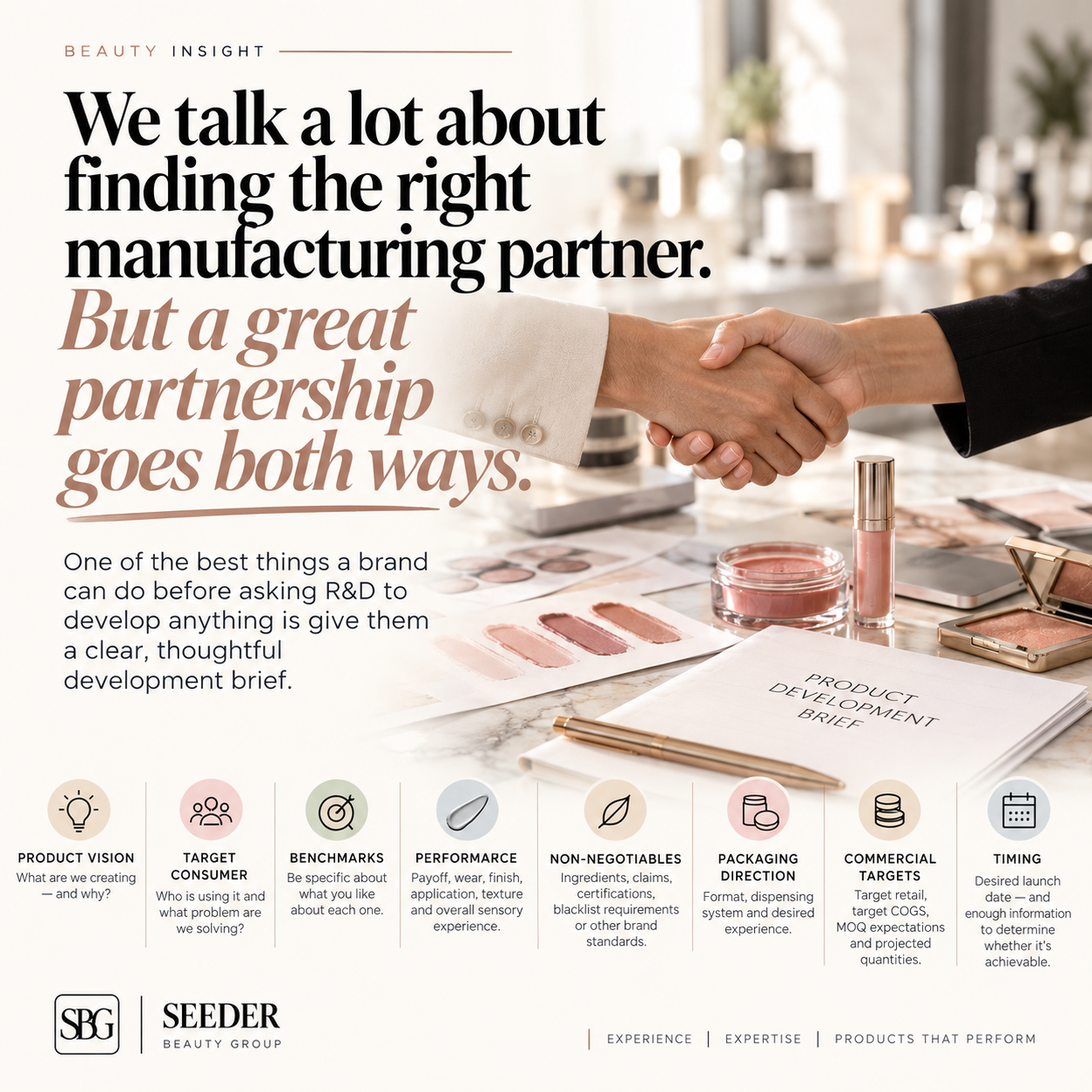
We talk a lot about finding the right manufacturing partner. But a great partnership goes both ways.
One of the best things a brand can do before asking R&D to develop anything is give the team a clear, thoughtful development brief.
Because even a highly capable chemist or manufacturer can't develop toward a target that hasn't been clearly defined.
“I want a beautiful glowy blush” may communicate the general idea.
But it isn't enough information to tell R&D exactly what you're trying to create.
The same is true when providing benchmark products. Sending several products to a lab and saying, “I want something like these,” still leaves a tremendous amount open to interpretation.
A benchmark isn't a brief
Benchmarks can be incredibly useful in development—but only when R&D understands what you like about them.
For example:
I want the texture of Product A.
The luminosity of Product B.
The payoff of Product C.
But I don't want the shimmer level of Product D.
Now you're giving R&D information they can actually work with.
The objective isn't necessarily to duplicate any of those products. It's to communicate the individual characteristics that help define the product experience you're trying to achieve.
Give R&D a target they can develop toward
A strong development brief should help answer questions such as:
What are we actually trying to create?
Define the product vision, category and what should make the product distinctive.
Who is the target consumer?
Who will use the product, and what need or experience are we designing for?
What should the product do?
Consider payoff, coverage, wear, finish, application, texture and sensory experience.
What are the non-negotiables?
Ingredient restrictions, claims, certifications, blacklist requirements, geographic requirements or other brand standards should be communicated early.
What does the packaging need to accomplish?
The intended format, dispensing system and desired consumer experience can influence development and should not be treated as an unrelated decision.
What are the commercial parameters?
Target retail price, target COGS, expected MOQs and projected quantities can all affect what is realistically achievable.
When does the product need to launch?
Timing matters because development, testing, packaging and manufacturing all require adequate lead time.
Clear direction doesn't mean telling the chemist how to formulate
This distinction is important.
The brand's role is to communicate what the product should be and how it should perform.
R&D's role is to determine how to formulate it.
You don't need to tell a chemist which raw material to change or how to solve a technical problem. You do need to give them enough information to understand the characteristic you're experiencing, what isn't meeting the target and what you want the result to be.
That shared understanding becomes especially important when development involves different teams, suppliers, manufacturers, countries and cultures.
The first submission doesn't have to be perfect
Even with an excellent brief, product development is an iterative process.
The goal of a strong brief isn't necessarily to receive a perfect formula on submission #1.
The goal is to make submission #1 a meaningful starting point.
Clear direction reduces unnecessary guesswork. It can help minimize avoidable sample rounds, miscommunication and development time while giving R&D a much better understanding of where the brand is trying to go.
And once samples begin arriving, that collaboration continues through thoughtful evaluation, clear feedback and ongoing communication.
The partnership starts before the first sample arrives
Selecting a capable manufacturer is incredibly important.
But so is giving that partner the information they need to do their best work.
The strongest development relationships aren't simply transactional exchanges between a brand asking for a product and a manufacturer making one.
They're collaborations built around a shared understanding of what you're trying to create.
The right manufacturing partner matters. But giving them the right direction matters, too.
That's where a great partnership begins.